

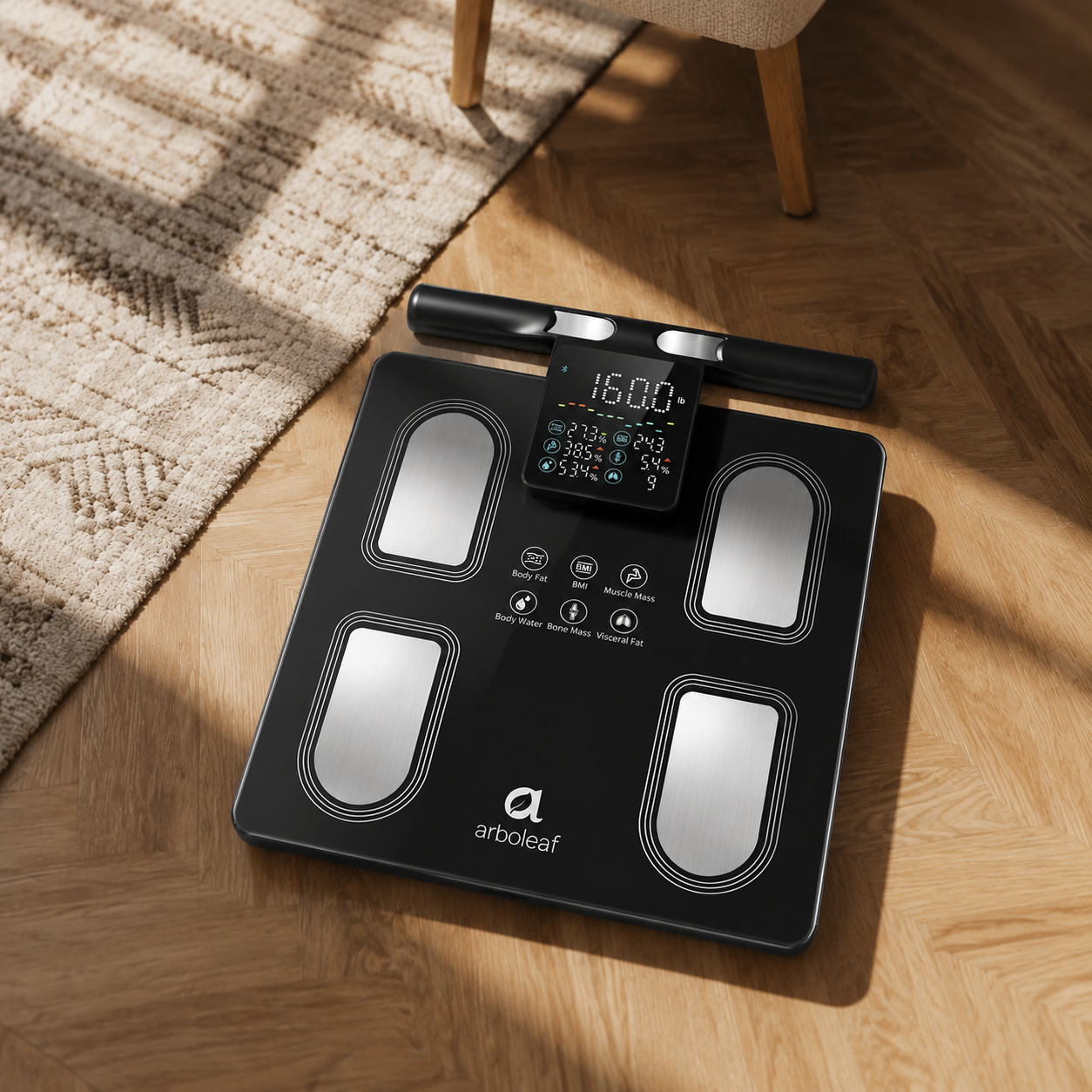
Have you ever stepped on the scale after weeks of healthy eating and working out, only to find the number hasn't budged? It is incredibly frustrating. But here is the truth: a single weight number is highly deceptive.
An isolated weight metric cannot distinguish between newly built muscle, burned fat, or just temporary water retention. Because of this massive blind spot, people are ditching traditional scales and upgrading to a smart scale to get a realistic picture of their progress.
If you are ready to stop letting a single number dictate your mood, this comprehensive smart scale guide will break down exactly how these devices work and what to look for when buying one.
What Is a Smart Scale?
Simply put, a smart body scale is an advanced home health monitor that connects to your smartphone via Bluetooth or Wi-Fi.
When you step on a standard scale, you get one flat number. But what is a smart scale actually doing differently? It comprehensively scans your internal makeup—breaking down your weight into body fat percentage, muscle mass, water content, and bone mass—and automatically syncs this data to an app to create an effortless, long-term health journal.
What Can a Smart Scale Measure?
The primary reason people upgrade to these devices is to access actionable data. When you open a high-quality companion app, you will see a variety of smart scale metrics. Here are the core indicators you should pay attention to:
| Metric | Why It Matters |
| Weight | Tracks the overall macro-trend of your body mass. |
| Body Fat % | A highly objective indicator of fat loss progress and overall leanness. |
| Muscle Mass | Evaluates your strength growth; more muscle increases your resting metabolism. |
| Body Water | Reflects your hydration status. Shifts in water usually explain sudden daily weight spikes. |
| Visceral Fat | The hidden fat stored around your abdominal organs; a crucial marker for cardiovascular wellness. |
| BMR (Basal Metabolic Rate) | The baseline calories your body burns at rest; essential for planning your nutrition. |
Beyond these standard measurements, modern devices offer highly personalized tracking experiences to fit your unique lifestyle. Many scales feature specialized settings, such as an Athlete Mode designed specifically for active individuals with higher muscle density, or a Zero-Current Mode for safely tracking basic weight during pregnancy.
Furthermore, all of this in-depth data is not only centralized in the manufacturer's app but can also be seamlessly shared with platforms like Apple Health or Google Fit, allowing you to track your daily activity and body composition progress in one unified place.
How Do Smart Scales Work?
You might be wondering: how do smart scales work if they aren't performing a physical medical scan?
They utilize an established technology called Bioelectrical Impedance Analysis (BIA). When you stand barefoot on the scale's sensors, it sends a tiny, completely painless micro-current through your body. Because muscle is rich in water and conducts electricity easily, while fat contains little water and creates resistance, the scale measures this "resistance value." It then runs that data through sophisticated algorithms to instantly calculate your body composition.
Want to explore the science and algorithms behind this technology? Read our in-depth guide: How Do Scales Measure Body Fat? Understanding the Technology Behind Smart Scales
Are Smart Scales Accurate?
When discussing smart scale accuracy, it is important to set realistic expectations by comparing home devices to clinical standards.
Research often compares consumer BIA smart scales to dual-energy X-ray absorptiometry (DEXA) scans—a highly precise medical test performed by healthcare professionals to measure body composition. Studies generally indicate that while a home smart scale may not perfectly match the absolute, pinpoint accuracy of a clinical DEXA scan for exact body fat percentages, there are no significant differences when it comes to measuring overall body weight reliably at home.
The true power of a smart scale isn't in medical-grade absolute precision on a random Tuesday, but in trend tracking. As long as you measure under consistent conditions (e.g., every morning on an empty stomach), the scale will accurately reflect the upward or downward trajectory of your fitness progress over time.
Why Weight Alone Doesn't Tell the Whole Story
Relying solely on weight can actively discourage you. Two people can both weigh 180 lbs, but one might have 30% body fat while the other, who lifts weights, has 15%. A traditional scale treats them identically.
If you recently started working out, you are likely burning fat while simultaneously adding denser muscle tissue. In this scenario, the number on the scale might not move at all. This is where smart scale benefits become invaluable. Instead of feeling defeated, your smart scale body composition report will reveal your muscle mass is climbing while your fat is dropping. Whether your goal is building strength or you are looking for a reliable smart scale for weight loss, seeing these internal shifts provides unmatched motivation.
What to Look for When Choosing a Smart Scale
If you are ready to let science guide your fitness journey, focus on these key features when making a selection:
-
Depth of Metrics: Look beyond basic body fat tracking. Advanced devices like the Arboleaf Smart Scale Collection can analyze over 50 detailed body metrics—ranging from subcutaneous fat to metabolic age—providing a panoramic view of your health.
-
Seamless App Ecosystem: Ensure the scale's proprietary app syncs automatically with your existing health ecosystem, like Apple Health, Google Fit, Fitbit, and Samsung Health, to prevent data silos.
-
Multiple User Profiles: Look for scales that support unlimited, independent user profiles so the whole family can track their trends without mixing up data.
-
Clear Trend Graphs: The app should generate clean, easy-to-read line charts by week, month, and year, allowing you to visualize your progress at a glance.
Frequently Asked Questions (FAQ)
Q: Is it really worth buying a dedicated smart scale?
A: Yes. Traditional scales provide too little context. A smart scale tells you whether you are gaining muscle or retaining water, and whether you are losing fat or losing bone mass. This data is the ultimate foundation for adjusting your diet and workout routines.
Q: How often should I weigh myself to get the most useful data?
A: To capture the most reliable trends, measuring daily or every other day is recommended. The most crucial factor is consistency in your measuring conditions: weigh yourself first thing in the morning, after using the restroom, barefoot, and before eating or drinking.
Q: Can I get my body fat percentage while wearing socks?
A: No. Because smart scales use micro-currents (BIA technology) to measure composition, fabric will block the current. Wearing socks will only yield your basic weight. You must be barefoot for the sensors to work properly.
Q: Are these scales safe for pregnant women or individuals with pacemakers?
A: Individuals with pacemakers or other implanted medical devices should strictly avoid using the BIA function, as the micro-current can interfere with the equipment. For pregnant women, while the technology is generally safe, the significant fluctuations in total body water and fluid volume during pregnancy make body composition readings inherently inaccurate.
Conclusion
Ultimately, health is a marathon, and true progress is reflected in long-term data trends rather than a single morning's weigh-in. A minor daily fluctuation of a pound or two is irrelevant; the structural optimization of your body composition is what truly matters.
The mission of a smart scale is not just to log your heaviness, but to give you the key to understanding how your body operates. When you stop stressing over weight plateaus and start watching your fat decrease and muscle climb on a chart, managing your health becomes a highly rewarding process. Keep showing up, stay consistent, and let the data prove that your hard work is paying off.
共有:
The Real Difference Between Pull Up and Chin Up: Your Ultimate Guide
Does a Smart Scale Actually Work? The Truth About Daily Fluctuations