Walk into almost any park and you'll find everything you need for an effective workout. A bench can replace several gym machines, a pull-up bar becomes a strength-training station, and an open patch of grass is enough for cardio and conditioning work.

The challenge isn't finding equipment—it's knowing which exercises to do and how to combine them into a balanced routine.

In this guide, you'll learn the best park workout exercises for every major muscle group, plus a simple full-body workout you can start using today.

Before You Start: Understanding Park Workout Exercises

When people search for best outdoor training routines, they’re usually looking for simple and effective ways to train outdoors using minimal equipment.

The key to a successful park workout is not doing random exercises, but following a balanced structure that targets your entire body.

A complete park workout should include:

  • Push exercises (chest, shoulders, triceps)
  • Pull exercises (back and biceps)
  • Lower-body exercises (legs and glutes)
  • Core exercises (stability and control)
  • Conditioning exercises (cardio and endurance)

This structure ensures that your park-based movements work together as a full-body training system rather than isolated movements.

Once you understand this framework, it becomes much easier to choose the right exercises and build an effective routine.

The movements below are grouped according to this structure, starting with upper-body training.

Upper-Body Park Workout Exercises

Push-Ups

Push-ups are one of the most effective bodyweight exercises for developing upper-body strength. They train the chest, shoulders, and triceps while forcing the core to remain engaged throughout the movement.

Although often viewed as a beginner exercise, push-ups remain a staple in advanced training programs because they can be easily modified. Beginners can use a park bench for incline push-ups, while experienced trainees can increase difficulty with decline or explosive variations.

How to Do It

  1. Place your hands slightly wider than shoulder-width apart.
  2. Engage your core and glutes to maintain a rigid, straight line from head to heels. Avoid letting your lower back sag.
  3. Lower your chest toward the ground, keeping your elbows tucked at a 45-degree angle to your torso to protect your shoulders.
  4. Push back to the starting position with a deliberate, powerful motion, exhaling as you reach the top.

Mastering the Movement

  • Focus on slow, controlled repetitions to engage your stabilizer muscles more effectively than fast, momentum-driven movements.
  • Use a sturdy park bench if your form breaks down; performing an incline variation allows you to perfect your posture and core engagement safely.
  • Progress gradually by moving from a high incline to a lower surface as you get stronger, eventually working your way down to floor push-ups.
  • Aim for 3 sets of 10 repetitions to start, then adjust the surface height or total volume as your fitness levels improve.

Pull-Ups

If your local park has a pull-up bar, this should be one of the first exercises you include in your workout.

Pull-ups train muscles that many people neglect, particularly the upper back and lats. They also improve grip strength and help balance the pressing movements commonly found in bodyweight training.

Because pull-ups require you to move your entire body weight, they can be challenging at first. However, even a few quality repetitions can provide significant strength benefits.

How to Do It

  1. Grab the bar with an overhand grip, slightly wider than shoulder-width.
  2. Hang with your arms fully extended and your core engaged.
  3. Pull your body upward by driving your elbows down until your chin clears the bar.
  4. Lower yourself under control back to the starting hanging position.

Mastering the Movement

  • Keep your torso stable throughout the movement to avoid swinging or using momentum to cheat the rep.
  • Ensure a full range of motion by fully extending your arms at the bottom and aiming for a clean pull at the top.
  • If you cannot complete a full rep, use a resistance band for assistance or focus on slow, controlled "negatives" (lowering yourself as slowly as possible).
  • Prioritize quality over quantity; start with 3 sets of 3–5 repetitions, gradually increasing the volume as your back strength improves.

Bench Dips

A park bench can be used for more than resting between sets. Bench dips are an effective way to target the triceps while also engaging the chest and shoulders.

This exercise works particularly well after push-ups because it continues to challenge the muscles responsible for pressing movements.

How to Do It

  1. Sit on the edge of a sturdy bench with your hands placed firmly beside your hips.
  2. Slide your hips forward off the bench, supporting your weight with your hands.
  3. Lower your body toward the ground by bending your elbows until they reach a 90-degree angle.
  4. Press back up using the strength of your triceps until your arms are fully extended.

Mastering the Movement

  • Keep your back close to the bench throughout the movement to maintain proper tension and protect your shoulder joints.
  • Avoid letting your shoulders shrug toward your ears; keep your chest open and your posture tall.
  • If you feel strain in your wrists, adjust your hand position or ensure the bench surface is stable before proceeding.
  • Aim for 3 sets of 10–12 repetitions; you can increase the challenge by extending your legs further away from the bench as you grow stronger.

Lower-Body Park Workout Exercises

Bodyweight Squats

Squats are one of the best lower-body exercises for building strength and improving athletic performance.

They train the quadriceps, glutes, and core while reinforcing movement patterns used in daily life. Since they require no equipment, squats are ideal for outdoor workouts and can be performed almost anywhere.

How to Do It

  1. Stand with your feet shoulder-width apart, toes pointed slightly outward.
  2. Initiate the movement by pushing your hips back as if sitting into an invisible chair.
  3. Keep your chest up, your core engaged, and your weight distributed across your feet.
  4. Lower your body until your thighs are nearly parallel to the ground.
  5. Drive through your heels to return to the starting position, squeezing your glutes at the top.

Mastering the Movement

  • Maintain a neutral spine throughout the movement to ensure you are effectively loading the target muscles and protecting your lower back.
  • Ensure your knees track in line with your toes rather than caving inward; this stability is key for joint health.
  • Control the tempo by taking 2 seconds to lower yourself and 1 second to rise, which increases time under tension for better muscle engagement.
  • Aim for 3 sets of 15 repetitions to start; as you get stronger, you can increase intensity by slowing down the movement or adding explosive jumps at the top.

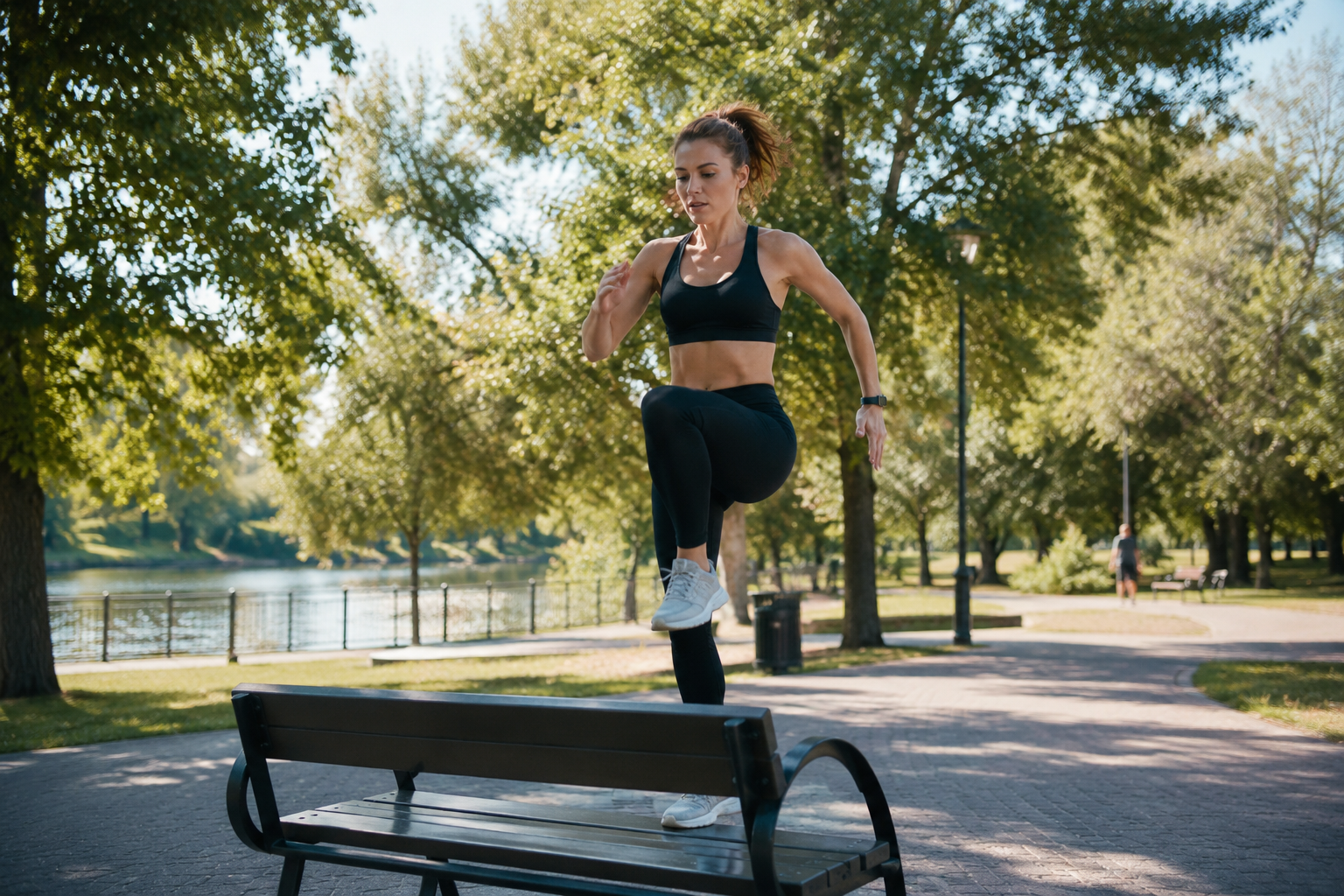
Bench Step-Ups

Step-ups are a simple but highly effective exercise that develops leg strength while improving balance and coordination.

Because each leg works independently, step-ups can also help identify and correct strength imbalances between sides.

How to Do It

  1. Stand facing a sturdy park bench with your feet hip-width apart.
  2. Place one foot firmly on the center of the bench.
  3. Drive through the heel of the foot on the bench to lift your body up until you are standing tall.
  4. Lower yourself back down under control, keeping your weight centered, and switch legs.

Mastering the Movement

  • Keep your core engaged throughout the movement to prevent your torso from swaying and to maintain stability.
  • Focus all your effort on the leg that is on the bench, minimizing any push-off from the foot remaining on the ground.
  • Maintain a slow and controlled descent to protect your knee joints; avoid jumping or dropping down quickly.
  • Aim for 3 sets of 10–12 repetitions per leg; as you progress, you can increase intensity by slowing down the tempo or performing the movement with more explosive power.

Walking Lunges

Walking lunges challenge the lower body in a way that feels more dynamic than stationary exercises. As you move forward with each repetition, your legs, glutes, and core must work together to maintain balance and stability.

This makes walking lunges particularly useful for improving functional fitness and athletic movement.

How to Do It

  1. Take a controlled step forward with one leg.
  2. Lower your hips until both knees are at roughly 90-degree angles.
  3. Push through your front heel to drive yourself back up.
  4. Bring your back leg forward into the next repetition and continue alternating sides.

Mastering the Movement

  • Keep your core engaged throughout the movement to prevent your torso from swaying.
  • Focus all effort on the leg on the bench, minimizing any push-off from the foot remaining on the ground.
  • Maintain a slow and controlled descent to protect your knee joints; avoid dropping down quickly.
  • Aim for 3 sets of 10–12 repetitions per leg, adjusting speed or adding power as you progress.

Core and Conditioning Exercises

Hanging Knee Raises

A strong core helps improve nearly every movement in your workout, from push-ups to sprinting.

Hanging knee raises are particularly effective because they challenge both the abdominal muscles and your ability to control body movement while suspended from a bar.

How to Do It

  1. Hang from a sturdy pull-up bar with an overhand grip.
  2. Keep your body stable and avoid letting your legs swing or sway.
  3. Engage your abs to raise your knees toward your chest in a smooth, controlled motion.
  4. Pause for a second at the top, then slowly lower your legs back down to the starting position.

Mastering the Movement

  • Focus on "tucking" your pelvis as you lift your knees, which ensures maximum contraction of the lower abdominal muscles.
  • Keep your upper body as still as possible; avoid using momentum or swinging your body to get your knees higher.
  • Breathe consistently throughout the set, exhaling forcefully as you raise your knees to deepen the contraction.
  • Start with 3 sets of 8–12 repetitions; as you get stronger, progress by straightening your legs to perform full hanging leg raises.

Burpees

If you're looking for one exercise that combines strength training and cardio, burpees are hard to beat.

They elevate your heart rate quickly while engaging nearly every major muscle group. For this reason, burpees are often used as a conditioning finisher at the end of a workout.

How to Do It

  1. Start from a standing position.
  2. Squat down and place your hands firmly on the ground.
  3. Jump your feet back into a strong, stable plank position.
  4. Jump your feet back toward your hands to return to a deep squat.
  5. Explode upward into a jump, extending your body fully before landing softly.

Mastering the Movement

  • Maintain a rigid plank during the floor phase; avoid letting your hips sag to protect your lower back.
  • Focus on fluidity; the movement should be a seamless transition from one step to the next rather than a series of choppy motions.
  • Land softly with slightly bent knees to absorb the impact and protect your joints during the final jump.
  • Start with 3 sets of 8–10 repetitions as a workout finisher; increase the pace or duration as your cardiovascular fitness improves.

A Simple 30-Minute Full-Body Park Workout

Not sure how to combine these outdoor exercises? Try this beginner-friendly routine.

Phase Exercise
Warm-Up (5 min) Brisk walk, light jog, dynamic stretches
Strength Circuit (15 min) Push-Ups, Pull-Ups, Squats, Step-Ups
Core Block (5 min) Hanging Knee Raises
Conditioning Finisher (5 min) Burpees

Complete the strength circuit for three rounds, resting only as needed between exercises. Adjust repetitions according to your fitness level.


Common Park Workout Mistakes to Avoid

  • Relying on a Single Exercise: Many people stick to push-ups alone, which can lead to muscular imbalances. Always include pulling and lower-body movements to ensure your training remains balanced.
  • Skipping the Warm-Up: It’s tempting to start immediately, but skipping your warm-up increases injury risk. Spend 5–10 minutes on dynamic movements to prime your muscles and improve performance.

  • Training Too Hard, Too Soon: Consistency beats intensity. Start with a manageable volume—prioritizing perfect form over quantity—and gradually increase your intensity as you get stronger.

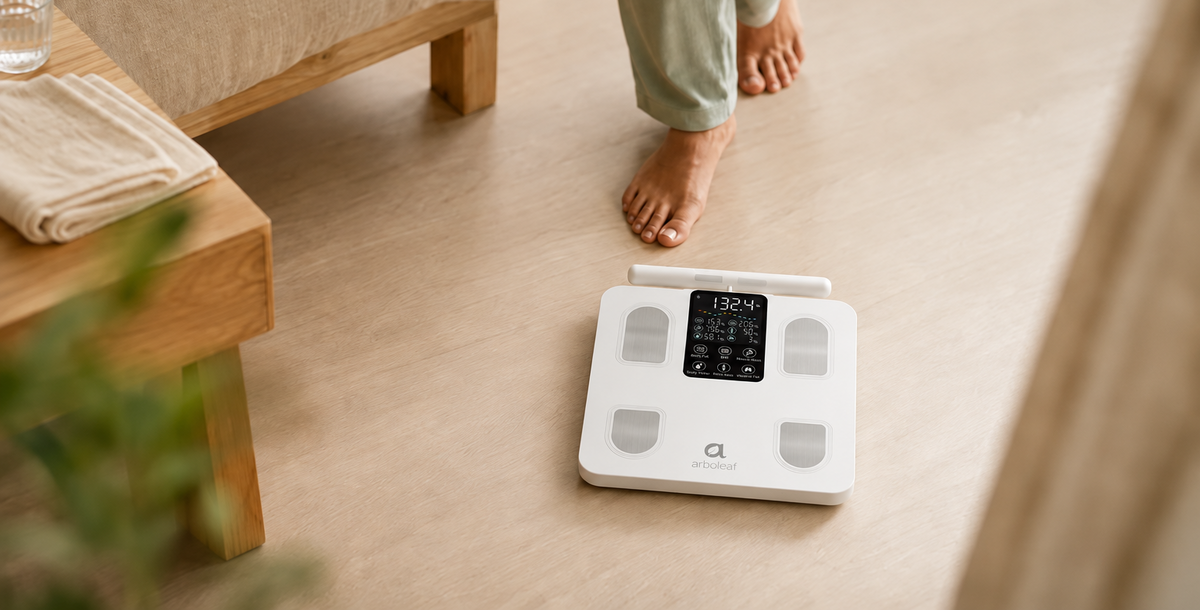
  • Ignoring Progress Data: Body weight alone is often misleading. Track comprehensive metrics like body fat percentage and muscle mass to see your real progress. Using a tool like the Arboleaf Smart Body Scale provides a clearer picture of your health journey, helping you make smarter, evidence-based training decisions.

Frequently Asked Questions

Q:Are park workouts effective for weight loss?

A:Yes. Combining strength exercises with conditioning movements like burpees can increase calorie expenditure and support fat loss.

Q:Can I build muscle with park workout exercises?

A:Absolutely. Push-ups, pull-ups, dips, squats, and lunges can all help build muscle when performed consistently and progressed over time.

Q:How often should I do park workouts?

A:Three to five sessions per week is a good starting point for most people.

Q:Do I need any equipment?

A:Most bodyweight movements rely on body weight alone, although access to a bench or pull-up bar can add more variety.

Conclusion

A great workout doesn't have to happen inside a gym. These park workout exercises can help you build strength, improve endurance, and stay active using little more than your body weight and your local park.

Pick a few exercises, get outside, and give them a try. And if you want to track your progress over time, an Arboleaf Smart Body Scale can help you keep an eye on key body composition metrics beyond weight alone.

Latest Stories

このセクションには現在コンテンツがありません。サイドバーを使ってこのセクションにコンテンツを追加してください。