

Picture a common daily scenario: you've spent a full workday slouched over a desk computer, or just finished an intense squat workout at the gym. By the time you head home exhausted, your lower back feels stiff and tight, and your calves are knotted with muscle tension.
Your body clearly needs proper recovery. When searching for relief, most people end up choosing between two popular options: reflexology and traditional massage.
These two wellness practices are often confused, yet they follow entirely different healing principles. What truly separates them? Which one works better for persistent body aches and muscle pain? Let's break down the key differences clearly.
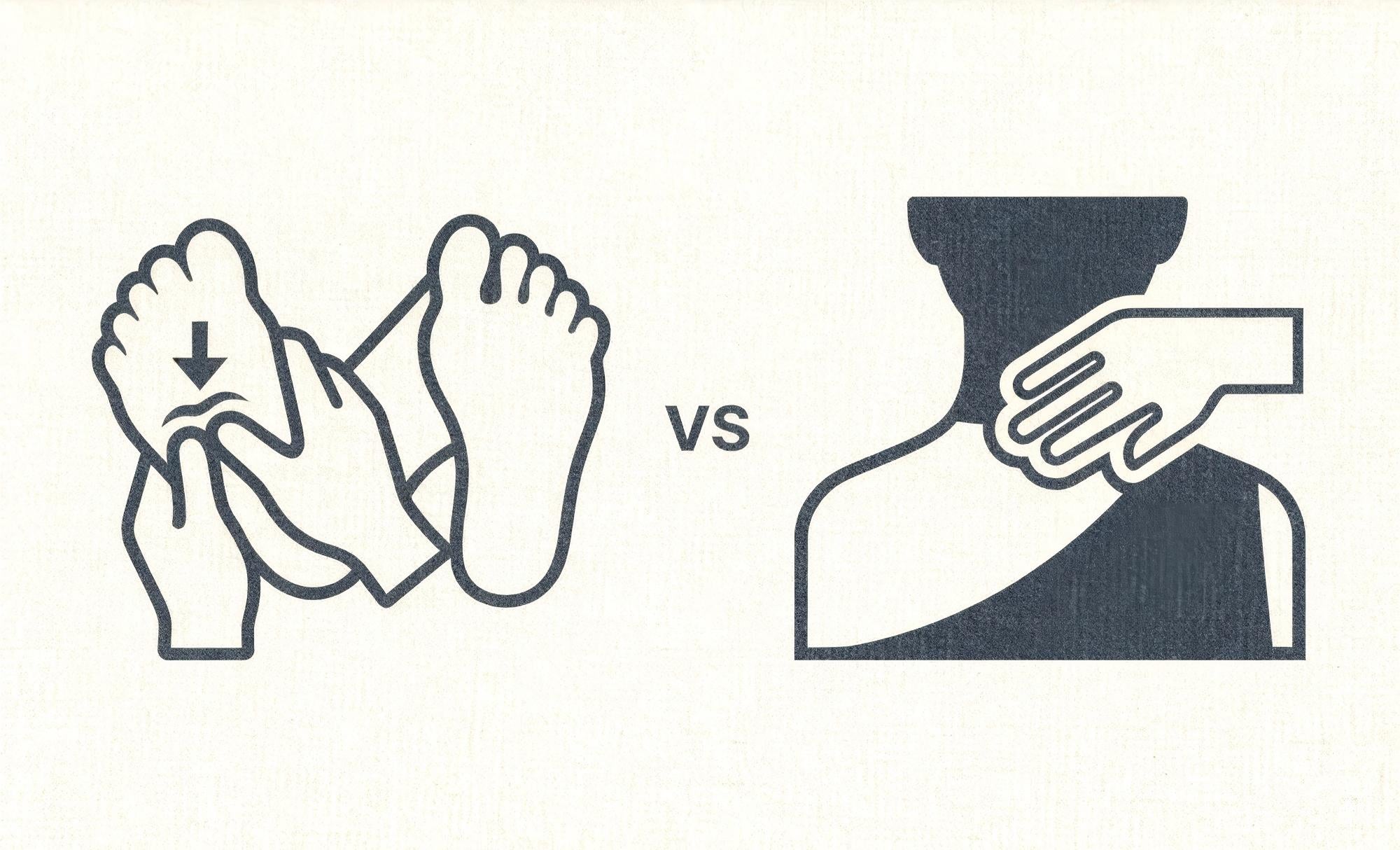
Core Differences: Remote Internal Regulation vs. Direct Muscle Relief
The biggest distinction lies in how each method addresses physical fatigue.
- Reflexology: Remote Internal Regulation
Reflexology is based on the theory that the feet contain reflex points mapped to the body's internal organs. A therapist applies targeted pressure to sensitive foot zones to stimulate the nervous system.
It works similarly to a remote control: pressing foot points is not meant to relax foot muscles alone. Instead, it sends nerve signals to the brain to help regulate sleep quality, digestion, and poor circulation in cold hands and feet. It is a gentle, holistic wellness approach that heals the body from the inside out.
- Traditional Massage: Direct Physical Repair
Traditional massage is a physical therapy focused on superficial muscles and deep fascia. Its core logic is simple: apply pressure exactly where stiffness occurs.
With techniques like pushing, kneading and tapping, massage physically releases metabolic waste trapped in tight muscle tissue. For office-related shoulder stiffness and post-workout muscle soreness, it delivers fast, direct physical relief.
A Detailed Comparison: Which Is More Suitable for You?
The table below compares their purposes, suitability, effects and limitations for easy reference.
| Dimension | Reflexology | Traditional Muscle Massage |
| Main Benefit | Regulates metabolism, improves cold extremities and digestive issues | Relieves muscle stiffness, reduces lactic acid buildup and relaxes tight fascia |
| Ideal For | People with sub-health problems: chronic late nights, insomnia and general fatigue | Sedentary office workers with back pain and fitness enthusiasts |
| Onset of Effects | Slow results; requires long-term consistent sessions | Fast relief; neck, back and leg tension eases immediately after one session |
| Pain & Experience | Often intense discomfort due to sensitive foot reflex points | Comfortable soothing soreness; pressure can be adjusted anytime |
| Time & Cost | Requires professional therapists; higher cost and time-consuming | More affordable; easy self-practice or at-home relaxation |
| Main Limitation | Less effective for severe neck tightness and lumbar muscle strain | Cannot regulate internal organ function; improper operation may cause injury |
Healing Mechanism: Why Both Methods Work Differently
You may wonder why foot pressure improves sleep while shoulder rubbing loosens tight muscles instantly. The body relies on different mechanisms to resolve different types of fatigue.
- For Internal Fatigue: Nerve Signal Regulation
Mental stress and irregular sleep disrupt the body's natural rhythm. Reflexology targets this imbalance by stimulating peripheral nerves on the feet. Precise pressure sends calming signals to the nervous system, helping internal organs restore natural balance. Professional training is required to locate accurate reflex points safely.
- For Muscle Stiffness: Physical Deep-Tissue Pressure
Prolonged sitting and intense workouts leave metabolic waste, such as lactic acid, accumulated in muscle fibers. Meanwhile, fascia—the connective tissue wrapping muscles—loses hydration and becomes adhered, causing a locked, stiff feeling.
To deal with the waste in the muscles and the adhered fascia, gentle stroking is largely ineffective. You must rely on physical force with a certain depth to squeeze the waste out and tear the adhesions apart—much like squeezing a sponge. This is exactly why traditional muscle massage works so quickly. However, in our daily lives, our own hands have limited strength and struggle to knead open deep muscles.
Because of this, many people use tools like the Arboleaf Massage Gun, utilizing the machine's high-frequency vibration to act as a substitute for manual force, easily addressing this purely physical soreness at any time.
Frequently Asked Questions
Q: Does more pain mean better results?
A: Not at all. The idea of “no pain, no gain” is a common misconception. Severe pain triggers involuntary muscle contraction and may lead to soft tissue strain. The ideal level is comfortable soreness instead of overwhelming discomfort.
Q: How often should I have relaxation therapy?
A: It depends on your physical condition. For daily muscle stiffness caused by sitting or exercise, 10 to 15 minutes of daily relaxation is recommended. For systemic internal regulation with reflexology, once every one to two weeks is ideal to allow the nervous system time to adjust.
Q: Can I combine reflexology and massage?
A: Yes. Many people prefer a full-body massage first to release shoulder and back tension, followed by a short foot reflexology session to calm the nervous system. The combination creates comprehensive full-body recovery.
Q: Why do I feel thirsty after a session?
A: Both therapies boost metabolism and push trapped waste into the bloodstream. Drinking water afterward supports kidney function and helps flush metabolic waste out of the body efficiently.
Conclusion
Choosing between reflexology and massage depends entirely on your current physical needs. If you suffer from high mental stress, poor sleep and overall sub-health, reflexology is an excellent choice for internal balance. If you struggle with neck and shoulder stiffness from prolonged sitting or post-workout muscle soreness, targeted soft-tissue massage delivers instant physical relief. Listen to your body and choose the right recovery method to maintain long-term physical wellness.
Share: